|
Everingham Family History
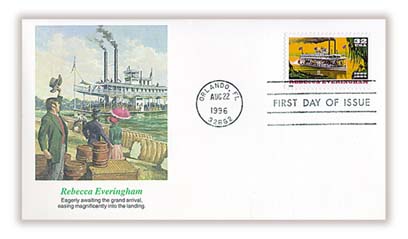
Rebecca Everingham
The Riverboat, the person
For more information about who Rebecca Everingham was,...
Read our HUGE transcript of the Diary of Sarah Louis Wadley who claims that the Riverboat was named after her mother.
Also see her family page on this web site.Here is a passage from the diary:
Friday, April 13th 1860. "Our baby is one week old today, he is still doing well and has grown a good deal since his birth, his name is John Everingham he is named for Mother's father."
|
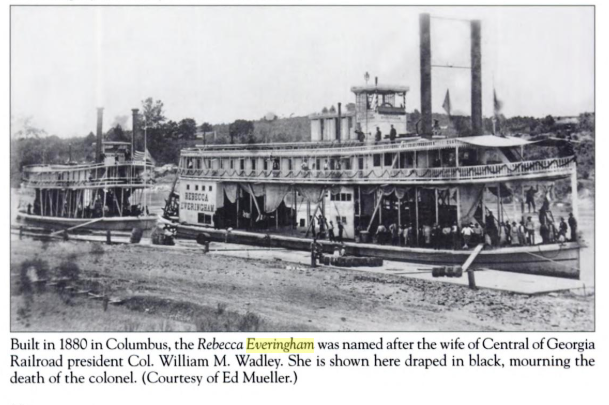
Photo circa August of 1882, Colonel Wadley died August 10, 1882.
About the Stamp & Riverboat:
Before railroads and automobiles, America's rivers served as the nation's "highways." 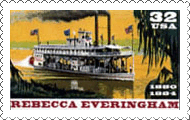 Twenty years after Robert Fulton's first steamboat run on the Hudson River in 1807, more than 200 steamboats were in use, hauling freight and passengers. In another 30 years, nearly one out of every two vessels on any major river in America was a steamboat. Steamboating was a lucrative industry in the United States for almost 150 years. Steamboat designs varied, and included side-wheel and stern-wheel paddlers, as well as powerful and majestic passenger vessels and heavily loaded cargo boats. Rivalries between steamboat pilots led to races that often had disastrous results. In the first 40 years of steamboats it was estimated that 500 vessels were lost, taking with them nearly 4,000 lives. Many of these boats were sunk taking unnecessary risks while racing, but some became grounded or hit a snag that punctured their hull and submerged the vessel. Because of the many dangers and accidents, the average life-span of a steamboat was only four to five years. The advent of efficient automobiles and transcontinental railroads in the late 19th and early 20th centuries led to the decline of the steamboat era. By the 1950s, the vessels had become relics of the past. The Rebecca Everingham, which was in service from 1880 until 1884, is featured on the First Day Cover shown above. Twenty years after Robert Fulton's first steamboat run on the Hudson River in 1807, more than 200 steamboats were in use, hauling freight and passengers. In another 30 years, nearly one out of every two vessels on any major river in America was a steamboat. Steamboating was a lucrative industry in the United States for almost 150 years. Steamboat designs varied, and included side-wheel and stern-wheel paddlers, as well as powerful and majestic passenger vessels and heavily loaded cargo boats. Rivalries between steamboat pilots led to races that often had disastrous results. In the first 40 years of steamboats it was estimated that 500 vessels were lost, taking with them nearly 4,000 lives. Many of these boats were sunk taking unnecessary risks while racing, but some became grounded or hit a snag that punctured their hull and submerged the vessel. Because of the many dangers and accidents, the average life-span of a steamboat was only four to five years. The advent of efficient automobiles and transcontinental railroads in the late 19th and early 20th centuries led to the decline of the steamboat era. By the 1950s, the vessels had become relics of the past. The Rebecca Everingham, which was in service from 1880 until 1884, is featured on the First Day Cover shown above.
This original painting by Dennis Lyall. Reverse of FDC contains historical background text.
Note: Several paintings and drawings of the Rebecca Everingham exist. |
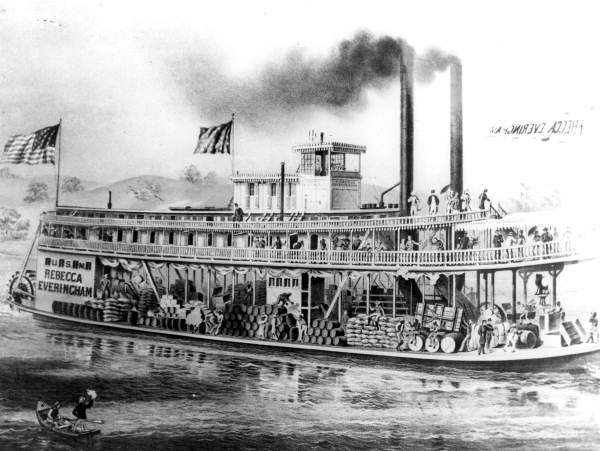
The Steamer Rebecca Everingham, in the news;
1880
- The Daily Enquirer-Sun, Columbus GA, August 28, 1880.. "The New Steamer Rebecca Everingham glides into the water. It took two hours to get her into the water. She was named Rebecca Everingham, this being the maiden name of the wife of Colonel Wm. M. Wadley, president of the Central railroad. Quite a large crowd had gathered to witness the launch. She has thrity state rooms and can accommodate 120 passengers. She is oak and will have two new steel boilers and use the engines of the Holt. The boilers are now being made in Pittsburg and will be received here about the middle of September. "
- Ledger-Enquirer, Columbus, GA, Sept 2, 1880.. "The workmen who came from teh west with the cabin for the Rebecca Everingham are making great headway in getting it in position. The steel boilers will arrive from Pittsburg about the 15th. It is thought she will be ready for business about October 15th."
- Ledger-Enquirer, Columbus, GA, Oct 20, 1880.. "Yesterday morning the last of the machinery of the steamer Rebecca Everingham was placed in position, and it was decided the new steel boilers should be tested. Accordingly the fires were litghted, and steam made. Everything was found to work admirably. The whistle sounded in triumph of the success. It is thought the trial trip will not be made until next week."
- The Ledger-Enquirer, Columbus, Georgia, Nov 16, 1880,.. "Rebecca Everingham, Her Trial Trip A thing of beauty! The new steamer, Rebecca Everingham, steamed up for her first trip yeasterday, and left the wharf at 4:30 for Apalachicola. The people lined the wharf and river bank to bid her good luck as she swung out info the stream. She is perhaps the finest steamer ever built in the south, and is prnounced by river men to be the finest boat that floats south of Mason & Dickson's line. She was built by the Central line under the supervision of Capt. Sam. J. Whitesides, and under the immediate superintendance of Capt. J.C. Blaine. She is 140 feet long on twenty inches water line, 155 feet over all with twenty-eight feet beam. She has 24 state rooms, all elegantly furnished and carpeted, a beautiful hall covered with bussels. Four chandeliers in the hall and the electric light. The painting in the cabin is so well executed that it gives the inside the finish of highly polished marble. Among those on the maiden voyage; Col. W.M. Wadley and lady, Capt. S.J. Whitesides, Capt. W.A. Fry, lady and children, Miss Peabody, John Stauffer, Charles Watt, Dr. J.M. Jordan, Miss Bettie Brown, Mrs. D.E. Williams, Miss Swift, S.D. Moore and others."
Of note, Col. William M. Wadley's lady mentioned above in this article, was the former "Rebecca Everingham" whom the steamer was named after.
- The Ledger-Enquirer, Columbus, Georgia, Nov 24, 1880,.. "The Rebecca Everingham leaves at ten o'clock this morning for Apalachicola. Captain George J. Whitesides, who commanded the Rebecca Everingham on her first trip and formerly commanded the Holt, will leave for Savannah, Ga., to take a similar position on the fine steamer Florida, also of the Central line. Capt. C.A. Klink takes charge of the Everingham, and goes out in control this morning."
- The Weekly Floridian, Nov 30, 1880.. "A new steamer, the Rebecca Everingham, has been launched at Columbus, Ga., to run on the Chattahoochee and Apalachicola rivers. She is said to be the finest steamer ever built in the South."
- The Ledger-Enquirer, Columbus, Georgia, Dec 8, 1880,.. "The steamer Rebecca Everingham leaves at 10 o'clock this morning for Apalach.. The river is very high and last afternoon was still rising."
- The Ledger-Enquirer, Columbus, Georgia, Dec 28, 1880,.. "A stewart county granger who went down the river to Florence on the Rebecca Everingham, reports that the biggest thing he saw in the way of Christmas tricks was 930 three gallon jugs on the boiler deck of the boat, consigned to various parties down the river."
1881
- Steamer shipping and passengers - Florida advertisement.
- Savannah Morning News, June 9, 1881 (Savannah, Georgia).. "The Columbus Times reports that Mrs. J.J. Flanders, of Macon, met with a most painful accident on the steamer Rebecca Everingham last Sunday. While the boat was coming up the river, below Bainbridge, it became necessary, for some reason, for Mrs. Flanders to stand upon a camp stool, and while in this position the stool turned over and she fell to the floor, breaking her arm just above the wrist. Dr. Mitchell, of Eufaula, was on board and set the wounded limb and rendered all the necessary medical aid."
- Ledger-Enquirer, July 12, 1881.. "From the parties who arrived on the steamer Rebecca Everingham yesterday, we learned that Capt. I.J. Williams died of rheumatism of the heart, at his home, a few miles from Marianna, Fla."
- The Weekly Floridian, Tallahassee, FL Sept 20, 1881.. "Passengers for Chattahoochee river boats connect with steamer Rebecca Everingham every Thursday for Apalachicola, Fla, and every Saturday for Columbus, Ga."
- Ledger-Enquirer, Columbus, GA, Oct 20, 1881.. "The steamer Rebecca Everingham, of the Central line, will resume her regular trips as soon as there is a rise in the river."
- Columbus Enquirer-Sun, November 12, 1881.. "Just as the steamer Everingham had cleared the wharf, and was turning around yesterday morning, a negro ran aboard the steamer Caddo Belle and attempted to jump aboard the former, but the leap was his last. The distance was too great for him, and he fell into the river. He floundered in the water, watched by fully fifty negroes and whites, not a one of whom made and effort to save him, and disappeared from sight. His name was Wiltz Porter, and he was employed by Mr. Benjamin Johnson, of Chattahoochee, Fla."

- Ledger-Enquirer of Columbus, Georgia, Dec 20, 1881.. "The Rebecca Everingham steamer was due yesterday, but at the time of going to press, she had not arrived. She will doubtless be at the wharf this morning."
- Ledger-Enquirer of Columbus, Georgia, Dec 21, 1881,.. "(On the Chattahoochee) The last trip of the regular Wednesday packet, the Rebecca Everingham, was characterized by a large freight and passanger list, the latter far exceeding in the grand total any that have been brought to Columbus with eighty-two cabin and about seventy-five deck passengers! "
- Savannah Morning News, Dec 22, 1881 .. "Columbus, GA, December 21, passengers by the steamer Everingham, just arrived, say that William Mahone killed J.P. Moberg at Greenwood, Florida. It appears that Mahone was at Greenwood ten days ago and while drunk in Moberg's store was attacked by him and severely beaten with a rope. On Friday night Mahone went to Greenwood and at first opportunity attacked Moberg with a hickory stick. On Moberg's attempting to run he was shot by Mahone in the back of the neck and killed almost instantly."
1882
- The Weekly Floridian, March 7, 1882.. "Last Friday there left from our wharf for up the river, two of the finest steamers of their size in the South - The new steamer Chattahoochee and the Rebecca Everingham. No other river in Florida can boast of two such splendid passenger steamers, so elegantly appointed and equipped as these two beautiful boats."
- Columbus Enquirer-Sun, May 11, 1882.. "Yesterday morning, when the steamer Rebecca Everingham arrived at the wharf, it brought the dead body of Mrs. I. Horseford of Cochran, Ga. Mr. J.M. Garrett, of Cochran, who was traveling with the lady, stated that she was subject to heart disease, and it was decided that it was of that disease that she died. Mrs. Horseford was an aged lady, probably more than seventy years old."
- Columbus Georgia Sunday Enquirer, May 21, 1882.. "The Eufaula Base Ball Club, Modocs, colored have challenged the Georga Champions, colored, of Columbus, for a game to be played at Eufaula. The Columbus boys will go down on the Steamer Everingham, Wednesday, and feel confident of becoming the victors in this important game."
- The Public Ledger Newspaper, Memphis, TN, July 19, 1882.. "Columbus, GA, A Southern Manufacturing City... Among the most extensive institutions of its class is the Columbus Iron Works, employing about 200 hands in making steam engines complete, and doing all kind of machinery and foundry work. They have also a boat building department. Now plying on the Chattahooche, between this point and Appalachicola are the steamers Wyly and Everingham, both built out and out from bow to stern, by the Columbus Iron Works."
- The Day News, New London, Connecticuit, Dec 19, 1882.. "Before the steamer Rebecca Everingham reached Otho on Monday, an old negro passanger, Wm. Dawkins, approached Capt. George Whiteside and stated that he had been robbed of $30 by one of the deck hands and a negro passanger. He led the way into the hold, where he pointed out Howard Hogan, deck hand and a negro passenger who gave his name as Tom Brown. Capt. Whiteside told Tom to walk upon the deck and give up the money, but he asserted that he didn't have it. The captain then went back into the hold to search of Hogan, but he had slipped out and taken a seat on some cross pieces above the boiler. Capt. Whiteside ordered Hogan to come down and give up the money. When the old man waled up on the cotton just in front of Hogan he remarked "that is the man." Hogan denied that he had the money and called the old man a liar at the same time jumping down and striking the old man a heavy blow in the stomach which sent him backward into the river. Capt. Whiteside caught his coat and attempted to save him. Before the steamer could stop and a boat lowered to rescue the old man, he went under to rise no more alive. Whiteside called a magistrate on board and delivered Hogan into custody. When arrested, he was coming out of the hold with a pistol in one hand and the money in the other. An attempt was made to arrest Tom Brown, but he prsented a dirk and threatened to kill the man who touched him. He jumped overboard and swam to the Georgia side. The two negroes had induced the old man to play at some one-sided game and swindled him out of his money. He was a well-to-do farmer, living near Marianna and it is said that he has two sons living in this city."
- Tri-States Union News, Dec. 22, 1882.. (page 4) "William Dawkins, an old man, was robbed Wednesday night while asleep in his state room on the steamer Everingham near Columbus, Ga. Thursday he accused Howard Hogan, a deck hand of being the thief. Hogan denied the charge and knocked Dawkins overboard. Before assistance could be rendered he was drowned. Hogan was arrested on charge of murder. On being searched the stolen money was found on him."
1883

- The Eufaula Daily Times, Eufaula, Alabama, Jan 21, 1883.. "An enterprise has been undertaken by a number of experienced steamboatmen headed by Capt. B.F. Marcrum and his son who recently piloted on the steamer Rebecca Everingham. Negotiations are now pending with parties to build an elegant steamer at once, which will be similar to the Everingham."
- Ledger-Enquirer News, March 20, 1883.. "Passangers on the Rebecca Everingham report that a heavy hail storm fell down the river yesterday about 12 o'clock, the stones being as large as a bird's egg. The Everingham arrived at 5 o'clock yesterday afternoon, bringing 106 bales of cotton, 57 barrels of syrup and 30 barrels of oysters, besides other miscellaneous freight."
- Ledger-Enquirer News, Apr 4, 1883.. "Sunday night, while the Everingham was plowing the waters, it was found that a minister on board, and at teh request of the passengers, services were held. Mr. J.S. Lovelace, the assistant pilot and chaplain led in prayer. After the choir had ended the benediction was pronounced, and everyone felt better after the spiritual repast.
There happened to be among our passengers and ordained minister of the Gospel, who, by request, held service and invited the passengers and crew to join him. We did so, and I believe with a feeling of reverence, and I know a manner suitable."
- Savannah Morning News, May 21, 1883.. "Wellington Playter, Esg, Dear Sir, some three months ago you placed two of Fordon's Patent Automatic Boiler Cleaners on the steamer Rebecca Everingham, now running on the Chattahoochee river. Before placing the Cleaner on her boilers it was impossible to keep them from bagging from time to time. Since placing them on her we have had no trouble with them. All the old scale has disappeared, and the boilers look as clean as when new. You are at liberty to use my name as a reference. I will take pleasure in giving any parties the actual working of the machine now on the boat who will take the trouble to write at this place, Yours respectfully, Sam'l J. Whitesides."
1884
- Annual Report of the Supervising Inspector General of Steamboats to the Secretary of the Treasury (Government Printing Office)... "April 3, 1884, Steamer Rebecca Everingham took fire on the Chattahoochee river, a few miles above Florence landing. Five passengers and seven of her crew were lost."
- Brooklyn Daily Eagle newspaper, Friday, April 4, 1884.. "(current events) Eight Lives were lost by the burning of the steamer Rebecca Everingham, on the Chattahoochee River, forty miles below Columbus, Ga. yesterday morning. There were twenty-five passengers on board, most of whom escaped in their night clothes. Several of the rescued persons were badly burned."
- Western Morning News, Plymouth, Devon, England, April 5, 1884.. "Eleven lives were lost by the burning of the river steamer Rebecca Everingham. There were forty one on board, and the whole might have perished but for the heroism of the pilot, who steered the vessel towards the shore with the flames surging around him. The fire attributed to a fragment of carbon of the electric light falling on the cotton."
- The Fredonia Censor, Wednesday, April 9, 1884... A Steamboat Horror Columbus, Ga., April 3 - The steamer Rebecca Everingham, Captain George Whiteside, burned to the water's edge at Fitzgerald Landing on the Chattahoochee river, 140 miles below this city. The fire originated in the stern of the steamer, and is thought from an electric lamp spark. Some passengers were saved and escaped in their night clothes. The boat was valued at $24,000 and is a total loss with no insurance. There were sixteen cabin passengers and nine deck pasengers on board. The steamer belonged to the Central Line and plied the Chattahoochee river between that city and Apalachacola Bay. A Macon dispatch says taht of thirty passengers, thirteen are dead and missing. Capt. George H. Whiteside was painfully burned. all the officers did their duty. The conduct of Pilot George Lapham and son, a lad of 14 years, is especially commended. They remained on board and materially assisted in landing the passengers.
- Image of "Burning of the steamer Rebecca Everinghama at Fitzgerald's landing, near Florence, GA."... From the Daily Graphic, New York, Wednesday April 9, 1884.
- The weekly Gleaner, De Ruyter, N.Y., Thursday, April 10, 1884... A River Horror Burning of a Southern Steamer with Loss of Life. People Aroused from Sleep to Meet Death by Fire or Water. The steamer Rebecca Everingham was burned on the Chattahoochee river, at Fitzgerald's plantation, a few miles above Florence Ala., at an early hour and many lives were lost. About 4 o'clock A.M. the engineer on watch rang an alarm signal to the pilot, who called to the officers on watch and asked if he must go to the shore when he was at once ordered to do so. The pilot signalled to the engineer to work for the shore, but got no response. He then headed the boat for the Georgia side, and the momentum she had, carried her almost to the banks. The pilot on watch ordered his young son, Frank Lapham, a youth of sixteen years old, to jump overboard with a line and swim ashore and make the boat fast to a tree. The boy sprang into the river, struck for the shore, reached it safely and tied the boat up. In the meantime teh fire alarm was rung by Pilot George Lapham, and the passengers aroused from their sleep to find the boat in flames. All was confusion and disorder, but the officers of the boat were heroic in the performance of their duty. Nearly all of them were wounded or burnt. The flames wrapped the boat in their fiery embrace and seemed to lick it up.
 Those known to be lost are as follows; W.L. Kennedy, Spring Hill, Ala., deputy sheriff of Barbour county; Mrs. Avart, Cuthbert, Ga,; Miss Simpson, Fort Gaines, Ga.; J.B. Yates, Bainbridge; two white men whose names were unknown; Julia Adams, colored chambermaid; Dolph Thomas, colored, fireman; Randal Singer and Aaz Stevens, colored deck hands; Bob Griffin, colored, stevedore and a colored woman and child, name unknown. Captain G.B. Whiteside was severely burned on the face, head, and hands, E.D. Williams of Langrange, Ga. was thought to be fatally burned. J.T. Carey, assistant engineer, was painfully burned. There were 307 bales of cotton aboard the steamer, 216 of which were taken on at Eufaula. She was made fast to the shore by two hawsers, which were finally burnt. She remained tied to the bank about fourty-five minutes, when her moorings burned and the wreck floated out in the stream, drifted about one hundred yards, careened and sunk. The fire broke out among the cotton just aft midship. It is not known how it originated. Those known to be lost are as follows; W.L. Kennedy, Spring Hill, Ala., deputy sheriff of Barbour county; Mrs. Avart, Cuthbert, Ga,; Miss Simpson, Fort Gaines, Ga.; J.B. Yates, Bainbridge; two white men whose names were unknown; Julia Adams, colored chambermaid; Dolph Thomas, colored, fireman; Randal Singer and Aaz Stevens, colored deck hands; Bob Griffin, colored, stevedore and a colored woman and child, name unknown. Captain G.B. Whiteside was severely burned on the face, head, and hands, E.D. Williams of Langrange, Ga. was thought to be fatally burned. J.T. Carey, assistant engineer, was painfully burned. There were 307 bales of cotton aboard the steamer, 216 of which were taken on at Eufaula. She was made fast to the shore by two hawsers, which were finally burnt. She remained tied to the bank about fourty-five minutes, when her moorings burned and the wreck floated out in the stream, drifted about one hundred yards, careened and sunk. The fire broke out among the cotton just aft midship. It is not known how it originated.
- Savannah Morning News, April 10, 1884.. "Fire drills are being given increased attention on the Chattahoochee boats since the burning of the Everingham."
- Castlemaine Mail, Victoria, Australia, May 22, 1884.. "Another marine disaster is reported from America, in this instance from fire. The Rebecca Everingham, a riverboat steamer, laden with cotton, and having 41 persons on board, passengers and crew, was totally destroyed by the fire near the town of Florence, in the state of Georgia."
|
Research of Kevin Everingham 1999 & 2012

|
|